Test the Skill, Not the Story: What Mis-Hires Reveal About Hiring Without Verification
An owner posted to r/smallbusiness in August 2026 under a title that admits the lesson. “Turns out I do need to test people on basic skills in the hiring process.” The complaint itself: “My newest employee lacks the most basic of computer skills after describing themselves as very comfortable working with computers.” The thread filled with identical stories. Everyone tests the product they buy. Almost nobody tests the people they hire.
Auto dealerships make the pattern expensive at scale. A store inspects every trade-in before writing a check, then staffs the sales floor on interview charisma. The new hire who claimed computer comfort cannot build a customer record in the CRM. Two weeks in, a manager is covering the desk, the CRM data is degrading, and the hiring ad is back up.
The usual response treats each mis-hire as bad luck. The pattern says otherwise. A hiring process with no verification step produces mis-hires at a predictable rate, and every one of them buys the same sixty to ninety days of coverage, re-recruiting, and re-training.
Testing the Question Against Real Tools
A fictional composite goes through the full diagnostic process below. Independent Auto Dealership Group does about $22M with 40 people. It has no skills verification beyond the interview, onboarding runs on shadowing whoever is free, and sales tenure averages about two years.
Every detail is invented, built from the sourced complaint above. The tool output is real. The VWCG Strategic Assessment returns a scored briefing from structured inputs. The businessconsultant.services diagnostic returns a written analysis from a plain-language description.
What the Assessment Found
The SWOT page shows the imbalance that defines this dealership: disciplined on assets, undisciplined on people.
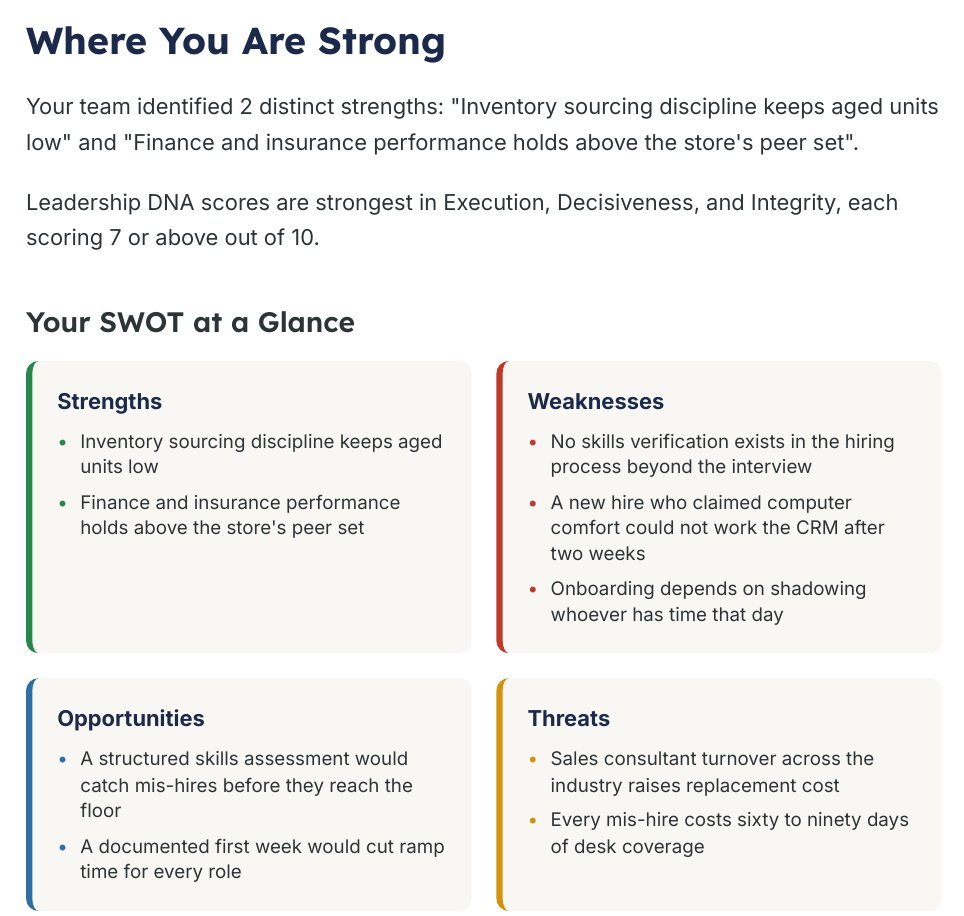
The strengths column holds the store’s asset disciplines: inventory sourcing keeps aged units low, and finance and insurance performance holds above the peer set. The weakness column holds the people process. No skills verification exists beyond the interview. A new hire who claimed computer comfort could not work the CRM after two weeks, and onboarding depends on shadowing whoever has time that day.
The threat column prices it. Sales consultant turnover across the industry raises replacement cost, and every mis-hire costs sixty to ninety days of desk coverage. The same store that would never buy a car without an inspection buys labor on a story.
The briefing’s cost pages extend the math past the hiring desk.
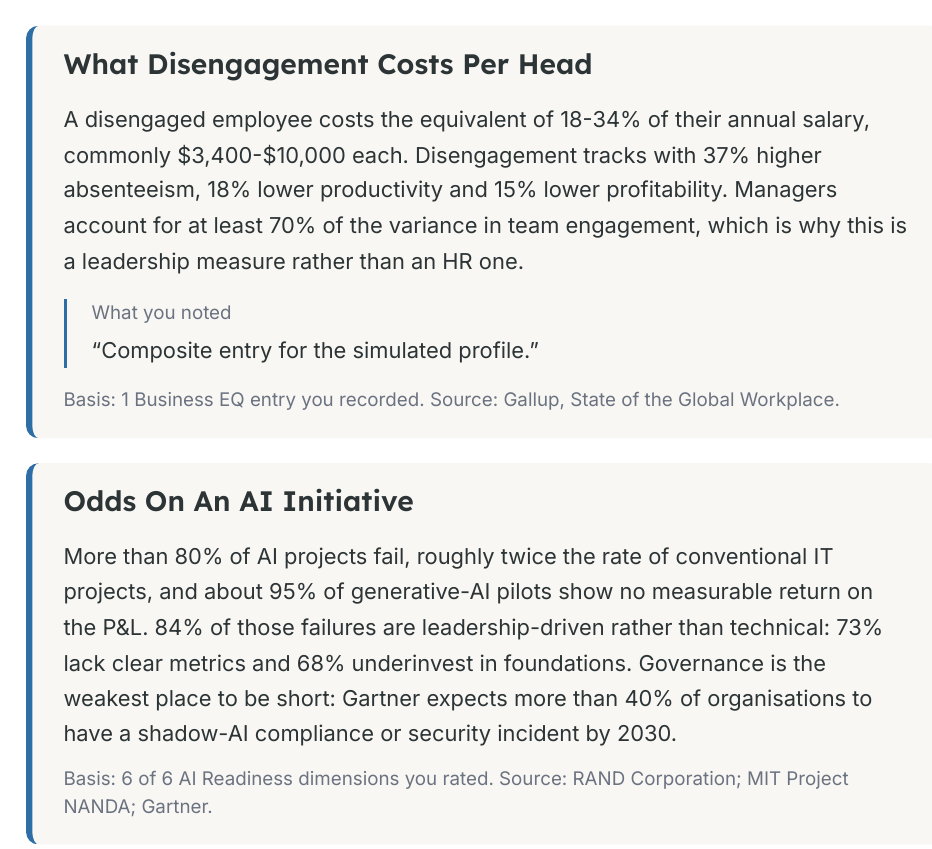
The per-head card puts disengagement at 18-34% of annual salary, commonly $3,400-$10,000 per employee, citing Gallup workplace data. Managers account for at least 70% of the variance in team engagement, which is why the briefing files this under leadership rather than HR. A second card prices the store’s automation appetite: most AI projects fail on leadership foundations, not technology, a warning against buying software to fix a hiring process.
What the Written Diagnostic Added
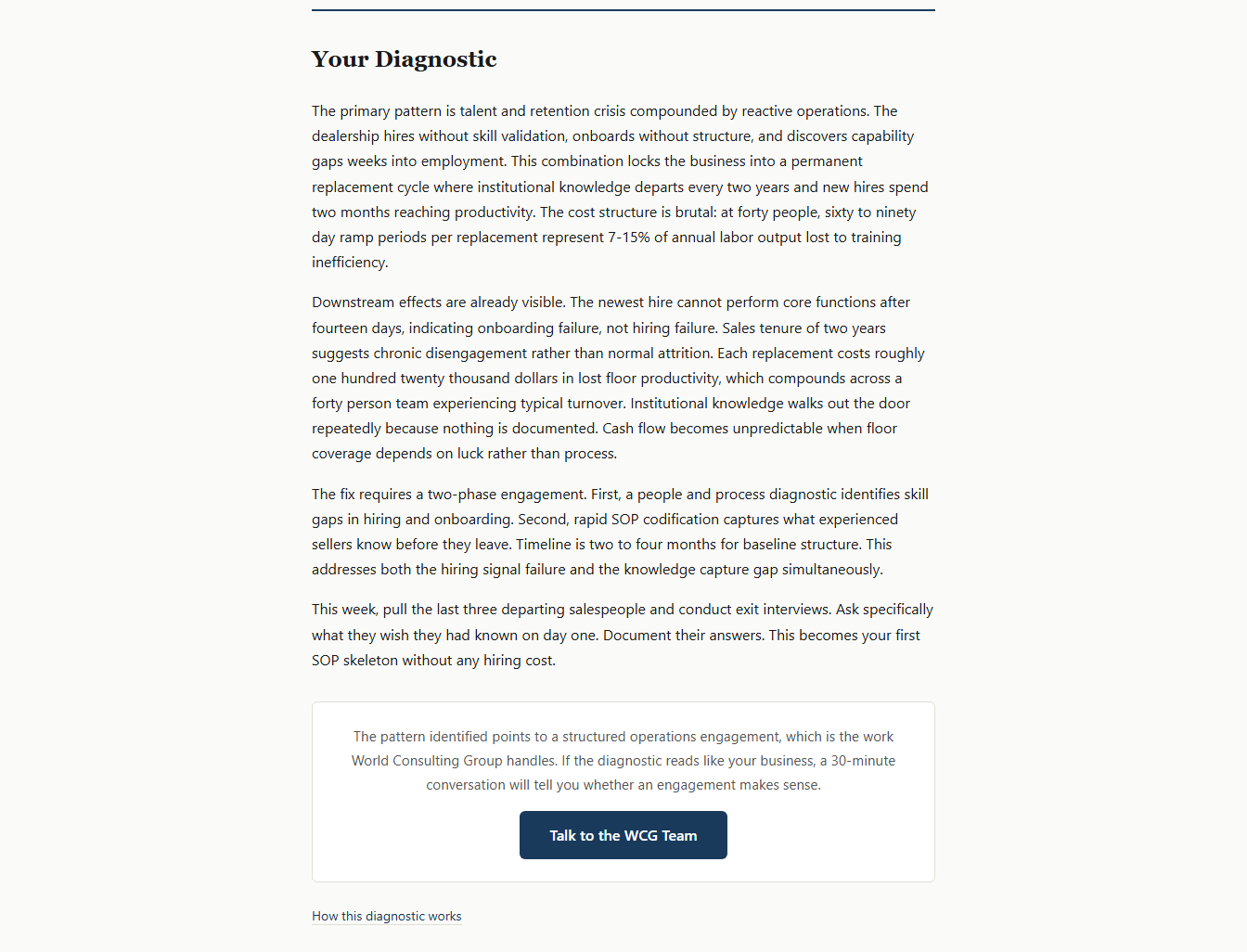
The written diagnostic named the pattern: talent and retention crisis compounded by reactive operations. The dealership hires without skill validation, onboards without structure, and discovers capability gaps weeks into employment. That combination locks the business into a permanent replacement cycle where institutional knowledge departs every two years.
Its sharpest move is a reframe. A newest hire who cannot perform core functions after fourteen days indicates onboarding failure, not hiring failure. The store never defined what day one through day five teach, so every hire’s ramp depends on who happened to be free. Nothing is documented, so knowledge walks out the door repeatedly, and floor coverage depends on luck rather than process.
The homework costs nothing. Pull the last three departing salespeople and conduct exit interviews. Ask specifically what they wish they had known on day one, and document the answers. That document becomes the first onboarding SOP skeleton, built without any hiring cost.
The Answer the Tools Assembled
The complaint asked how a self-described computer-comfortable hire turned out unable to use one. The combined answer: the store verified nothing, taught nothing on a schedule, and measured tenure in hindsight. Three structures close the loop.
Test before offer. A 20-minute working assessment on the actual tools of the role: build a customer record, log a follow-up task, draft an appointment confirmation. The assessment listed a structured skills test as the top opportunity because it catches mis-hires before they reach the floor, where they cost the most to discover.
Onboard on paper, not on availability. A documented first week, owned by a named trainer, with a checklist the hire signs off. Documented processes that actually run beat shadowing because shadowing transfers habits, not standards.
Track tenure as a cost line. NADA Dealership Workforce Study data, drawn from more than 250,000 payroll records, puts sales consultant turnover at 66 percent, up 12 points, with median tenure of 2.2 years. A store that knows its own numbers can price every point of turnover reduction, which is what turns retention from a slogan into a budget item. Rising turnover is one of the patterns that predict a stall long before revenue shows it.
The 90-Day Sequence
Days 1 to 10. Run the three exit interviews and write the day-one-to-five onboarding skeleton from the answers, exactly as prescribed.
Days 11 to 30. Build the role skills assessment from the CRM tasks the job actually requires. Pilot it on current staff first to calibrate the pass bar, then attach it to every open requisition.
Days 31 to 60. Assign onboarding ownership. One named trainer per department, one checklist per role, sign-off required. Track fourteen-day capability the way the store tracks aged inventory.
Days 61 to 90. Review the numbers monthly: assessment pass rate, fourteen-day capability rate, and ninety-day retention. The persona’s target of 36-month median tenure is a two-year project measured in ninety-day increments.
Run the Same Diagnosis on Your Business
The walkthrough used a fictional dealership. The tools accept real inputs and return the same class of findings, priced in the store’s own numbers. The VWCG Strategic Assessment takes about 10 minutes and scores the people process with the same discipline stores already apply to inventory.
A business that inspects every asset it buys and none of the people it hires has a verification gap, not a labor market problem. Test the skill, not the story.
Kamyar Shah has led 650+ consulting engagements, including fractional COO, fractional CMO, executive coaching, and strategic advisory, producing over $300M in client impact across companies in the $1M-$50M range. He built the VWCG Strategic Assessment from the same diagnostic frameworks he uses in paid engagements.
Ready to assess your business?
Get clear visibility into your gaps with our free tools.
Start Free Assessment