When Net 30 Becomes Net 60: Receivables Discipline for Businesses That Pay Weekly
An owner posted this to r/smallbusiness in August 2026: “But lately these bigger companies are acting like Net 30 means Net 60. They just ignore the due date completely.” The replies split between factoring pitches and resignation. Both responses accept the premise that a customer, not the business, decides when invoices convert to cash.
Trucking carriers live this at its most brutal, because their cost clock runs weekly. Fuel settles weekly. Driver payroll settles weekly. The revenue for the load that burned that fuel arrives whenever a shipper’s payables department processes it, and large shippers know exactly how long a small carrier can wait.
The generic advice says charge late fees or factor the receivables. Late fees on a customer that already ignores due dates are a memo, not a mechanism. Factoring costs real margin to outsource a discipline the business never built.
The complaint is not about one slow shipper. It is about a business with no receivables system letting its largest customers write its cash policy.
Testing the Question Against Real Tools
A fictional composite goes through the full diagnostic process below. Flatbed Trucking Carrier runs about $5M with 19 trucks. Rate confirmations say Net 30 and larger shippers pay at sixty days or later. Collections happen only when cash gets tight, and no credit review happens before taking on a new shipper.
Every detail is invented, built from the sourced complaint above. The tool output is real. The VWCG Strategic Assessment returns a scored briefing from structured inputs. The businessconsultant.services diagnostic returns a written analysis from a plain-language description.
What the Assessment Found
The SWOT page shows a healthy operation wrapped around a cash discipline hole.
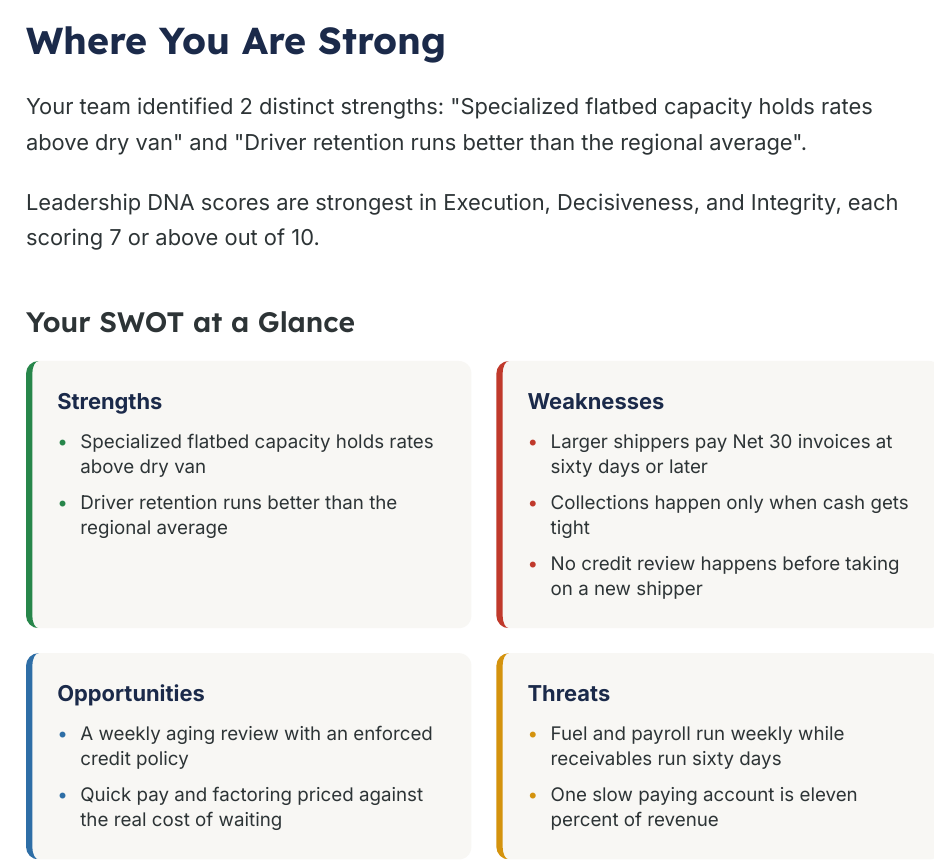
The strengths are operational: specialized flatbed capacity holds rates above dry van, and driver retention runs better than the regional average.
The weaknesses are all one system. Larger shippers pay Net 30 invoices at sixty days or later. Collections happen only when cash gets tight. No credit review happens before taking on a new shipper.
The threat column states the squeeze in one line: fuel and payroll run weekly while receivables run sixty days, and one slow-paying account is eleven percent of revenue. The opportunities column already contains the cure the tools will prescribe. A weekly aging review with an enforced credit policy, priced against quick pay and factoring at the real cost of waiting.
The cost page converts the pattern into scores.
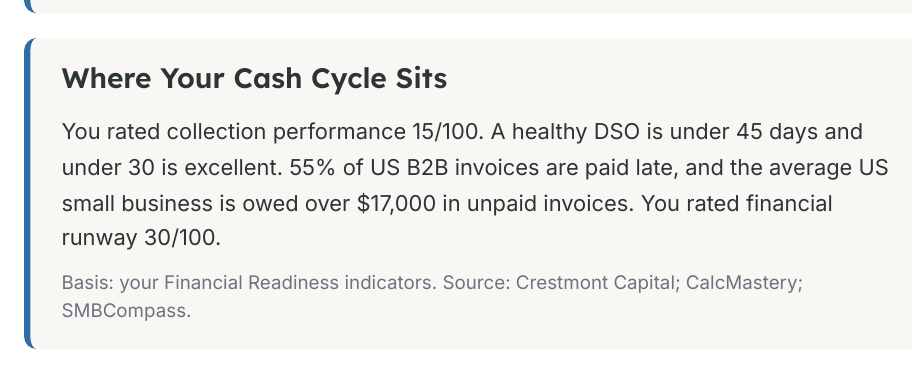
Collection performance rates 15 out of 100. The card’s benchmark line notes a healthy days-sales-outstanding runs under 45 days, with under 30 excellent, and pairs it with a financial runway rating of 30 out of 100. Low runway plus slow collections is the specific combination that turns one bad month into a credit line draw.
What the Written Diagnostic Added

The written diagnostic named the pattern reactive operations compounded by founder dependency, then explained the trap hiding inside growth. Outstanding receivables grow faster than cash reserves can absorb them, so each new truck adds weekly cash burn before its revenue lands. Growth makes the squeeze worse, not better.
Two sentences in the output earn their place on a wall. With one shipper at eleven percent of revenue and payment delays of thirty days beyond terms, the business carries roughly two months of operating costs in unpaid invoices. And the verdict: the business is funding customer operations rather than its own growth.
The homework is specific. Audit the last twelve months of invoices by shipper and calculate days sales outstanding for the top five customers. Document exactly how much cash each shipper is holding. Then schedule calls to discuss Net 30 enforcement with the three largest accounts before month end.
The Answer the Tools Assembled
The complaint framed the problem as customer behavior. The tools reframed it as missing structure, in three parts.
Credit discipline before the first load. A credit check and terms agreement precede hauling, the way documented process beats improvisation everywhere else in the business. A shipper that will not clear a credit review at onboarding is announcing its payment behavior in advance.
A weekly aging review with named escalation. Receivables reviewed every Friday, past-due accounts escalating on a schedule instead of when the fuel account runs low. The persona’s north star, days sales outstanding under 40, is the right instrument because it moves weekly and everyone can see it.
Price the waiting, then decide. Quick-pay programs and factoring have a cost, and so does carrying two months of operating expenses interest-free for customers. A carrier that knows its real cost of waiting can negotiate terms, offer a small early-pay discount, or walk, using arithmetic instead of anxiety. A business that cannot fund its own growth plan has usually loaned that funding to its customers.
The industry context makes the discipline more valuable, not less. FMCSA Drug and Alcohol Clearinghouse counts put 202,345 CDL holders in prohibited status, 159,226 of whom never started the return-to-duty process. Capacity is structurally constrained. A carrier with clean receivables and a credit policy can afford to say no, and in a constrained market the carrier that can say no sets its own terms.
The 90-Day Sequence
Days 1 to 10. Run the twelve-month invoice audit exactly as prescribed. DSO per shipper for the top five, cash held per shipper, on one page.
Days 11 to 30. Hold the three enforcement calls with the largest accounts. The ask is not a favor. It is the terms both parties signed, backed by the audit numbers.
Days 31 to 60. Install the Friday aging review and the escalation ladder: reminder at day 25, call at day 35, credit hold at day 50. Write the credit policy for new shippers and apply it to the next quote.
Days 61 to 90. Measure DSO weekly against the under-40 target. Reprice or exit the accounts that ignore two cycles of enforcement. Eleven percent of revenue that pays at sixty days is worth less than nine percent that pays at thirty.
Run the Same Diagnosis on Your Business
The walkthrough used a fictional carrier. The tools accept real inputs and return the same class of findings, priced in the company’s own numbers. The VWCG Strategic Assessment takes about 10 minutes and scores collection performance and runway directly from the financial readiness inputs.
A customer that treats Net 30 as Net 60 is running a test. A business with a receivables system passes it, and a business without one becomes the lender of first resort.
Kamyar Shah has led 650+ consulting engagements, including fractional COO, fractional CMO, executive coaching, and strategic advisory, producing over $300M in client impact across companies in the $1M-$50M range. He built the VWCG Strategic Assessment from the same diagnostic frameworks he uses in paid engagements.
Ready to assess your business?
Get clear visibility into your gaps with our free tools.
Start Free Assessment