Business Assessment: What It Covers and How to Run One
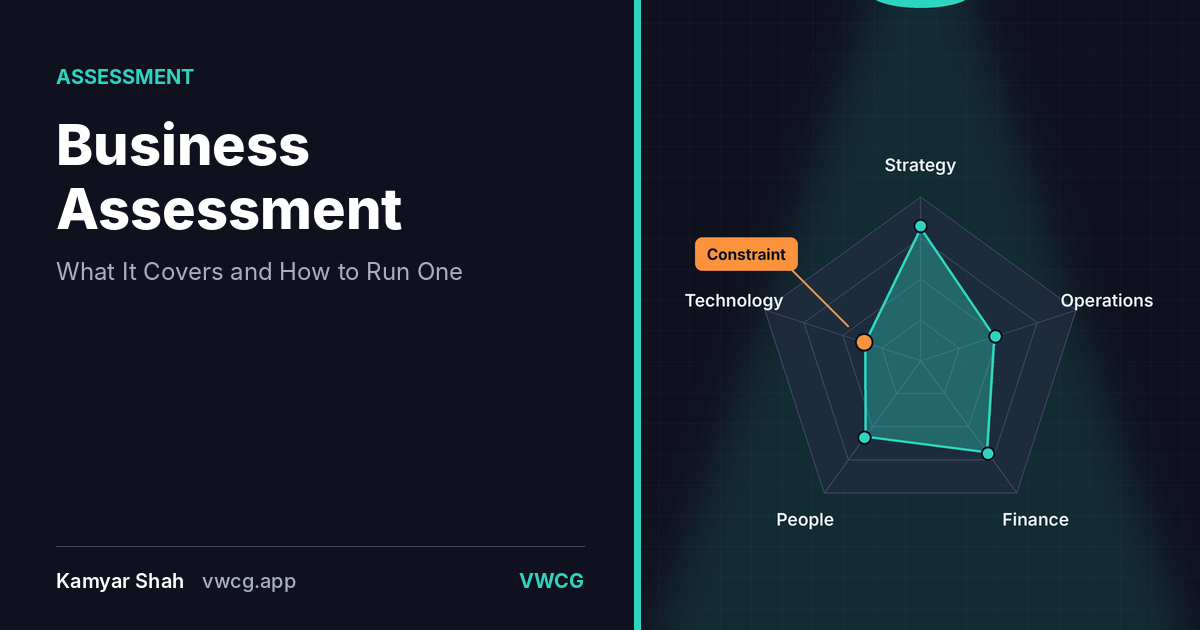
A business assessment is a structured review of how well a company’s strategy, operations, finances, people, and technology work together. It replaces unsupported opinions with evidence-based priorities. A well-run business assessment can help the owner identify the two or three constraints most likely to matter, so the next quarter of effort is better targeted.
What a Business Assessment Is For
Most owners already know something is wrong before they look for an assessment. Growth has slowed, margins are thinner than expected, or the owner cannot step away for a week without problems piling up. What they lack is a clear view of which problem causes the others.
A business assessment answers that question with structure. It looks at the company in defined dimensions, scores each one against a consistent standard, and then compares the scores. The pattern across dimensions usually matters more than any single score.
That comparison is the point. Strong sales with weak delivery calls for a different next step than strong delivery with no repeatable way to win clients. Without an assessment, both companies tend to try the same generic fixes and get uneven results.
A business assessment answers whether the whole business engine is sound. When the narrower question is whether the leadership system can execute, an organizational health assessment is the better tool.
The Five Areas Every Business Assessment Should Cover
A useful assessment covers the whole business, not just the area that hurts most. The areas below form a practical baseline for companies between a few million and a few tens of millions in revenue.
Strategy and direction. Is there a clear choice about which customers to serve and which offers to sell? Do the leaders describe the strategy the same way, and does the budget reflect it?
Operations and delivery. Are the core processes documented and followed? Does work move between teams without constant escalation, and can the company deliver a normal week without the owner resolving conflicts?
Financial health. Are the numbers accurate, timely, and trusted? Does the company understand its margins by offer and its cash position for the next few months?
People and leadership. Do roles and decision rights match the size of the company? Are the managers developing, or is every hard decision still routed to the founder?
Technology and AI readiness. Do the systems support the processes, or do teams work around them? Are employees already using AI tools, and does the company know which ones and for what?
Each area deserves its own score, but the interactions between them deserve the most attention. Weak decision rights, for example, often show up first as an operations problem and later as a financial one.
Self-Assessment vs Outside Assessment
A self-assessment costs little and can be completed quickly. It works well as a first pass, especially when several leaders answer the same questions separately and then compare their answers. Gaps between leaders’ answers are often the most useful finding.
The limitation is blind spots. Owners tend to rate their own areas of strength generously and their areas of discomfort harshly, or the reverse. Teams that have lived with a problem for years can stop seeing it as a problem at all.
An outside assessment adds an independent view, a consistent standard across companies, and experience with patterns that repeat. It costs more and takes longer. For most growing companies, the practical sequence is a structured self-assessment first, then outside help on the two or three areas the first pass flags. This site’s breakdown of what a strategic business assessment costs covers the price tiers in detail.
How to Run a Business Assessment in Five Steps
- Choose a consistent framework, so every area is scored against written criteria instead of impressions.
- Ask several leaders to complete the assessment separately, without discussing their answers first.
- Gather a small set of evidence for each area, such as recent financials, a process document, and an organization chart.
- Compare scores across leaders and across areas, and mark the largest gaps and the lowest scores.
- Pick no more than three constraints to address in the next quarter, each with one owner and a review date.
The fifth step is where most assessments fail. Owners leave with a long list of findings and try to fix everything at once. A short list with clear owners produces more change than a long report that sits in a folder.
Signals That a Business Assessment Is Overdue
Some situations call for an assessment sooner rather than later. Revenue has grown but profit has not followed. A key manager has left and nobody else understands their part of the business. The owner works more hours each year while the company feels harder to run.
Other signals are quieter. Meetings end without decisions, and the same customer complaint returns every few months. Employees use their own tools and workarounds because the official process does not fit the work.
Any one of these signals justifies a structured review. Several at once suggest the business has outgrown the structure that carried it to its current size.
What a Good Assessment Report Contains
A good report is short enough to act on. It starts with a scored summary of each area, followed by the two or three constraints that explain most of the other problems. Each constraint comes with evidence, so leaders can see why it was chosen.
The report should also separate symptoms from causes. Late deliveries might be the symptom, while unclear ownership of handoffs might be the cause. Treating the symptom produces short-term relief and a return of the same problem a few months later.
Finally, the report should name next steps in plain terms: what to change, who owns the change, and how progress will be measured. Recommendations that cannot be assigned to a person tend not to happen.
Common Mistakes When Assessing a Business
The first mistake is assessing only the department that hurts. A sales problem can start in delivery capacity, and a cash problem can start in pricing. A narrow review finds the symptom and misses the cause.
The second mistake is letting one leader’s view stand in for the whole team. Separate answers from several leaders surface disagreements that a single perspective hides. Those disagreements are often the real constraint.
The third mistake is treating the assessment as a one-time event. Businesses change quickly as they grow, so repeating the same structured assessment every year or after a major change shows whether the fixes actually worked.
Start With a Structured Self-Assessment
For most growing companies, a structured self-assessment is the right first step. It costs nothing but time, it produces a common language for the leadership team, and it shows where outside help would actually pay off.
The VWCG Strategic Assessment is built for exactly that first step. It covers strategic, operational, and financial foundations along with leadership and AI readiness, and returns a report with scores, gaps, and directional recommendations. Access is by invitation.
Request access to the assessment ->
Kamyar Shah has led 650+ consulting engagements across a dozen-plus industries, including fractional COO and strategic advisory work. He built the VWCG Strategic Assessment from the same diagnostic frameworks he uses in paid engagements.
Ready to assess your business?
Get clear visibility into your gaps with our free tools.
Start Free Assessment